Cavity Wall Insulation Grants 2026: Who Qualifies & How to Apply
Cavity wall insulation grants are available through ECO4 and the Warm Homes Local Grant, covering the full cost for eligible low-income households. Cavity wall insulation fills the gap between inner and outer walls, reducing heat loss by up to 33% and saving approximately £295 per year on energy bills.
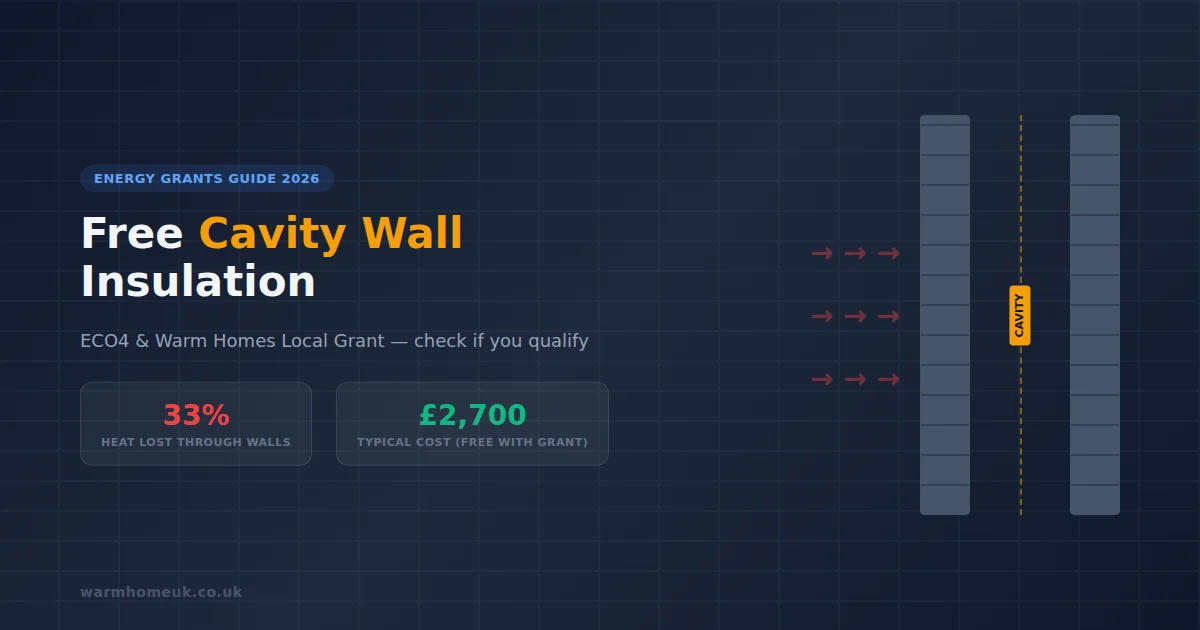
According to the Energy Saving Trust, about 33% of all heat lost in an uninsulated home escapes through the walls. Cavity wall insulation is one of the most effective insulation upgrades to cut that heat loss — and if you're on a low income, you can get it done completely free.
Two government schemes currently fund free cavity wall insulation: ECO4 (closing December 2026) and the Warm Homes: Local Grant. Here's how to find out if you qualify.
Do I Have Cavity Walls?
Before applying, you need to know what type of walls your home has. According to the Energy Saving Trust:
- Houses built after the 1920s usually have cavity walls — two layers of brick with a gap between them. This includes most homes in cities like Liverpool and across England
- Houses built from the 1990s onwards usually already have wall insulation
- Pre-1920s homes usually have solid walls (no cavity) — these need different insulation
How to check
- Measure the wall at a doorway or window — if it's 260mm to 350mm thick, it's likely a cavity wall
- Check the brick pattern — if all bricks are laid lengthways in an even pattern, it's probably a cavity wall. Alternating long and short bricks suggest a solid wall
- If your walls are rendered or clad, ask a professional to assess them
Could you get free cavity wall insulation?
Your eligibility depends on your income, benefits, and property EPC rating. Our checker tells you in 2 minutes.
Which Grants Cover Cavity Wall Insulation?
| Scheme | Cost to You | Where | Key Requirement | Ends |
|---|---|---|---|---|
| ECO4 | Free | England, Scotland, Wales | Benefits or LA Flex referral | Dec 2026 |
| Warm Homes: Local Grant | Free | England | Income under £36,000 | 2028 |
Do You Qualify for Free Cavity Wall Insulation?
We check your postcode, EPC rating, and income against ECO4 and the Warm Homes Local Grant — the two schemes that fund free cavity wall insulation.
Check My Eligibility — FreeHow Much Does It Cost Without a Grant?
According to the Energy Saving Trust, cavity wall insulation for a typical home costs around £2,700 in Great Britain (around £1,000 in Northern Ireland).
The EST says it takes less than five years to pay back through energy bill savings — and it lasts the lifetime of the building with no maintenance.
How Much Heat Will I Save?
The Energy Saving Trust says about 33% of heat in an uninsulated home escapes through the walls. Insulating your cavity walls reduces this significantly, cutting your heating bills and making your home more comfortable. The exact savings depend on your property size, heating system, and energy tariff.
ECO4 — Free Cavity Wall Insulation (Ends December 2026)
ECO4 is the main route for free cavity wall insulation across Great Britain. It's funded by energy suppliers and covers homes in England, Scotland, and Wales.
Who qualifies
- You receive a qualifying benefit — Universal Credit, Pension Credit, Income Support, Income-based JSA or ESA, Child Tax Credit (income under £18,500), or Housing Benefit
- Or your council refers you under ECO4 LA Flex — typically household income below £31,000, or a health condition worsened by cold housing
- Your home has an EPC rating of D, E, F, or G
- Your cavity walls are currently uninsulated
⚠️ ECO4 closes 31 December 2026 with no successor scheme announced. If you're eligible, apply now — check your eligibility or contact your energy supplier. Demand increases as the deadline approaches.
Warm Homes: Local Grant — Free Cavity Wall Insulation
The Warm Homes: Local Grant can also fund cavity wall insulation at no cost. It's delivered through your local council in England.
Who qualifies
- Household income of £36,000 or less — or you live in an eligible postcode area, or someone receives qualifying benefits
- EPC rating of D, E, F, or G
- Privately owned or privately rented property in England
Apply at gov.uk/apply-warm-homes-local-grant or call 0800 098 7950.
What to Expect During Installation
Cavity wall insulation is relatively quick and causes minimal disruption:
- Survey — An assessor checks your walls, identifies the cavity type, and confirms suitability. They'll also check for damp, damaged brickwork, or other issues that need fixing first.
- Drilling — Small holes (about 22mm) are drilled into the mortar joints at regular intervals across the external wall.
- Injection — Insulation material (usually mineral wool or bonded beads) is blown into the cavity through the holes.
- Sealing — The holes are sealed and colour-matched to your mortar. From the outside, you'd barely notice.
- Completion — The whole process usually takes a few hours for a standard home.
When Cavity Wall Insulation Isn't Suitable
According to the Energy Saving Trust, cavity wall insulation may not be suitable if your home:
- Is exposed to extreme weather or flooding
- Is in poor condition — damaged brickwork, faulty guttering, or damp must be fixed first
- Has narrow cavities (less than 50mm) — common in pre-1920s homes
- Has existing damp issues that haven't been resolved
If cavity wall insulation isn't suitable, you may still qualify for loft insulation, solid wall insulation, or heating upgrades through the same schemes.
⏰ ECO4 closes December 2026 — some suppliers have already met their targets
Don't wait until the deadline. Check what you qualify for while both schemes are still open.
Check Before It's Too LateScotland and Wales
- Scotland: ECO4 covers cavity wall insulation. You can also apply through Home Energy Scotland for additional support and advice.
- Wales: ECO4 covers cavity wall insulation. The Nest scheme also provides free home energy improvements for eligible households.
Frequently Asked Questions
Does cavity wall insulation cause damp?
Properly installed cavity wall insulation should not cause damp. However, the Energy Saving Trust stresses that any existing issues — damaged brickwork, faulty guttering, roof leaks — must be repaired before installation. A professional assessment will check suitability before any work begins.
How long does cavity wall insulation last?
Cavity wall insulation is designed to last the lifetime of the building when properly installed. It requires no maintenance.
Can I get cavity wall insulation if I rent?
Yes. Both ECO4 and the Warm Homes Local Grant cover privately rented properties. Your landlord will need to give permission, and under the Warm Homes Local Grant, they may need to contribute to the cost.
I don't receive benefits — can I still qualify?
Yes. The Warm Homes Local Grant accepts households with income below £36,000, regardless of benefits. Your council can also refer you under ECO4 LA Flex if you're on a low income or have a health vulnerability — councils like Hull and Nottingham have dedicated teams for this.
What if I have solid walls, not cavity walls?
Solid wall insulation is also available through ECO4 and the Warm Homes Local Grant. It costs more and takes longer to install, but it's effective for older homes. An assessor will recommend the right approach for your property.
What about the Great British Insulation Scheme (GBIS)?
GBIS closed to new applicants in October 2025 and formally ends on 31 March 2026. It is not accepting new applications. ECO4 and the Warm Homes Local Grant are the main alternatives.
Cavity Wall Insulation Grants in Your Area
Eligibility varies by council. Check what's available near you:
Further reading
Free Loft Insulation Grants 2026
Eligibility, how to apply, and what to expect
Free Heat Pump Grants 2026
BUS, ECO4, and Warm Homes Local Grant compared
Energy Grants for Pensioners 2026
Pension Credit, Winter Fuel Payment, and more
Warm Homes Local Grant: Complete Guide
How to apply, eligibility, and what's covered
☀️ Are Solar Panels Worth It in 2026?
Honest answer with real savings by city and free calculator
Important: WarmHomeUK is an independent service and is not affiliated with or endorsed by the UK Government, the Department for Energy Security and Net Zero, or Ofgem. Eligibility results are indicative and subject to official assessment. This content does not constitute financial or legal advice.
Written by Forhad Sarker
Forhad has worked inside the UK solar installation industry and now runs WarmHomeUK to make government grant information accessible. He tracks scheme changes across 300+ councils, reads the policy documents, and cross-references every guide against official gov.uk sources.